

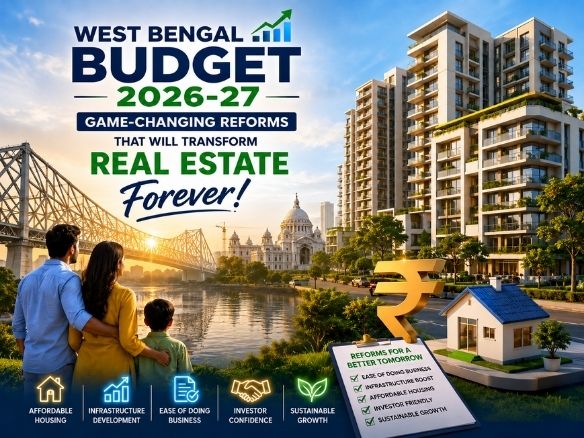
Welcome back to the Propserve.in insights blog. If you are an investor, a prospective homebuyer, or someone looking to upgrade your living space, we understand that buying property carries immense financial and emotional weight. For months, the real estate market has been holding its breath, anticipating the West Bengal Budget 2026-27. Many homebuyers were waiting on the sidelines hoping for a reduction in property taxes or a reinstatement of pandemic-era stamp duty rebates.
Let us cut through the noise: the rebates did not return. However, what the ₹4.38 trillion state budget delivered instead is arguably much more powerful for long-term wealth creation. The government has engineered a massive pivot from simple welfare distribution to aggressive, infrastructure-led development. With a staggering ₹40,000 crore infrastructure push, the state is fundamentally redrawing its real estate map. Let’s break down the facts, the new policies, and exactly what this means for your property investments.
The Game Changer: Reviewing the Urban Land Ceiling Act
Perhaps the most monumental announcement for the state’s real estate sector is the government’s commitment to re-examine the archaic Urban Land (Ceiling and Regulation) Act of 1976. West Bengal is the only major state in India where this law is still in force, severely restricting the aggregation of large, contiguous land parcels.
If this act is relaxed or repealed, it will unlock vast tracts of developable urban land. For investors and homebuyers, this means we will finally see the rise of modern, master-planned integrated townships, massive commercial complexes, and organized residential sprawl rather than fragmented, piecemeal developments.
Ease of Doing Business: Boosting Commercial & Residential Demand
To attract corporate capital and accelerate project delivery, the budget introduced several “blockbuster” operational reforms. When businesses thrive, the demand for both commercial office space and residential housing skyrockets.
- Single-Window Clearance: Mega-projects with investments of ₹100 crore or more will bypass local panchayat and district delays via a state-level, technology-driven single-window clearance system. This means faster construction timelines and fewer delays for your booked apartments.
- The End of the “Syndicate Raj”: The government has committed to strict legislation to eradicate informal extortion and local syndicate pressures. This guarantees a safer operational environment for developers, which translates to better construction quality and timely handovers for buyers.
- 24×7 Commercial Operations: The state is amending laws to allow shops, restaurants, and offices to remain open 24 hours a day. This will significantly boost rental yields for premium retail and commercial high-street spaces.
- AI and Data Center Incentives: To fuel the digital economy, the state is offering 100% stamp duty reimbursements, electricity duty waivers, and Floor Area Ratio (FAR) relaxations specifically for Artificial Intelligence data centers. This positions Kolkata’s peripheries to capture global tech investments.
Infrastructure Corridors: Where Will Property Values Rise?
Infrastructure is the single biggest driver of real estate appreciation. The 2026-27 budget directs capital to specific corridors, turning them into high-growth investment zones.
| Location / Region | Key Budget Project | Expected Real Estate Impact |
|---|---|---|
| Kalyani / NH-12 Corridor | New Greenfield Airport (1,000–1,500 acres) | Surge in residential townships, logistics hubs, and hospitality real estate. |
| Eastern Kolkata / New Town | ₹900 Crore Chingrighata-New Town Elevated Corridor | Accelerated absorption of Grade-A commercial spaces; appreciation in mid-market residential units due to slashed commute times. |
| Durgapur–Asansol Belt | Semiconductor Unit & Metro Rail Feasibility Study | Transition from heavy industry to a high-tech corridor, driving demand for diversified, mid-income residential housing. |
| Purba Medinipur (Coast) | Deep-Sea Port at Dadanpatrabar (PPP Model) | Massive demand for port-proximate warehousing, logistics parks, and industrial real estate. |
Taxes, Income, and Homebuyer Affordability
While the highly anticipated stamp duty cuts did not materialize—keeping rates at 6% to 7% for urban properties and a standard 1% registration fee—the government introduced powerful income boosters that will increase home loan eligibility.
- Massive Job Creation: The government announced the filling of 1,000,000 public sector vacancies, with 33% strictly reserved for women. Formal employment increases bankability, driving immense demand for mid-segment housing.
- DA Hikes & Cash Transfers: State employees will receive a massive 20% hike in Dearness Allowance (DA), taking the total to 38%. Furthermore, the ₹36,000 crore Annapurna Yojana ensures steady cash transfers to female beneficiaries. This sustained liquidity improves household financial stability, directly elevating mortgage affordability.
Propserve’s Advice: The Bottom Line
At Propserve.in, our mandate is to protect your interests and provide clarity. The West Bengal Budget 2026-27 is exceptionally growth-oriented, transitioning the state into a multi-polar real estate market.
Our Strategic Recommendation: Do not delay your purchase waiting for stamp duty reductions; the state’s aggressive revenue targets suggest these are not returning anytime soon. Instead, position your capital where the infrastructure is heading. We strongly advise looking at mid-segment residential properties along the EM Bypass-New Town axis to leverage the upcoming ₹900 crore elevated corridor. Alternatively, early investments in land or affordable housing around the proposed Kalyani Airport corridor offer substantial medium-to-long-term upside.
Suggested Related Articles
- The Complete 2026 Guide to West Bengal Stamp Duty & Registration Fees
- The ₹900 Crore Catalyst: Investing Along the New Town Elevated Corridor
- Understanding WBRERA: How Digital Transparency Protects Your Investment
Frequently Asked Questions (FAQs)
Industry Voices: What Renowned Real Estate Leaders Are Saying
You do not just have to take our word for it. The 2026-27 West Bengal Budget has triggered strong reactions from the most prominent voices and veteran developers in the state’s real estate sector. While the overall sentiment is highly optimistic regarding infrastructure and regulatory ease, industry leaders have also pointed out areas that need careful execution.
Here is how the top minds in the industry are decoding the budget:
- Sushil Mohta, President of CREDAI West Bengal: Welcomed the review of the Urban Land Ceiling Act. He noted that rationalizing this framework, combined with introducing a new township policy similar to those in Gujarat and Maharashtra, would finally facilitate access to the larger land parcels needed to support organized, planned urban development. He also emphasized that the focus on better connectivity and job creation will naturally drive housing demand.
- Rishi Jain, Managing Director of Jain Group: Praised the government’s direction, highlighting “three blockbuster industrial reforms”: dismantling the syndicate system, reducing local-level hurdles through single-window clearance, and reviewing the Urban Land Ceiling Act. However, he urged the government to go a step further and abolish the archaic land legislation entirely to truly accelerate growth.
- Joydeep Paul, Senior Director at Knight Frank India: Described the land ceiling review as “a noteworthy reform that could improve land availability and facilitate greater private sector participation”. Pointing to the new IT parks and semiconductor units, he noted that these initiatives will successfully “create specialised economic hubs and generate demand for commercial, residential and social infrastructure”.
- Siddharth Pansari, Director of Primarc Group: Focused on the operational relief for builders, stating that “continued efforts to bring more transparency, reduce reliance on informal practices and address issues like syndicate culture can significantly improve execution on the ground and strengthen investor confidence”.
The One Major Caveat: Affordable Housing
Despite the overwhelming praise for infrastructure and commercial reforms, the industry expressed a collective concern regarding the affordable housing segment. Because the budget did not introduce targeted tax relief or revise the price caps for affordable homes, development bodies like CREDAI have warned that the share of affordable housing could shrink from nearly 18% to just 12% of the total housing supply. This means lower-middle-income homebuyers may face tighter supply and rising costs in the near future.
Did the 2026-27 Budget reduce property stamp duty in West Bengal?
Ans. No. The stamp duty remains normalized at 6% for urban properties under ₹1 crore, and 7% for properties above ₹1 crore, plus a standard 1% registration fee. The 2% pandemic-era rebate remains discontinued.
How will the repeal of the Urban Land Ceiling Act help homebuyers?
Ans. Currently, the 1976 Act restricts developers from acquiring large blocks of land. Reviewing or repealing this act will allow reputed developers to build massive, beautifully planned integrated townships with better amenities, rather than small standalone buildin
Why is Kalyani suddenly a hotspot for real estate investment?
Ans. The state budget announced the identification of 1,000 to 1,500 acres near Kalyani for a second major greenfield commercial airport. Airport infrastructure historically triggers rapid land appreciation, driving massive demand for residential, commercial, and logistics real estate in the 20-30 km catchment area.
Will the new 24×7 operations policy affect residential areas?
Ans. The policy amending the Shops and Establishment Act to allow 24×7 operations is primarily targeted at commercial spaces, retail, and hospitality. It will heavily boost commercial real estate yields, but premium residential areas closely integrated with these commercial hubs may see increased demand from the growing workforce.
Disclaimer: Propserve.in is a RERA-registered real estate advisory firm. The information provided in this article is for educational and informational purposes only, based on current market trends and the West Bengal Budget 2026-27. We are not a government entity or a real estate developer. Property markets are subject to economic fluctuations and execution risks. Please consult with our expert advisors for personalized financial and property investment strategies.

Join The Discussion