

Quick Navigation
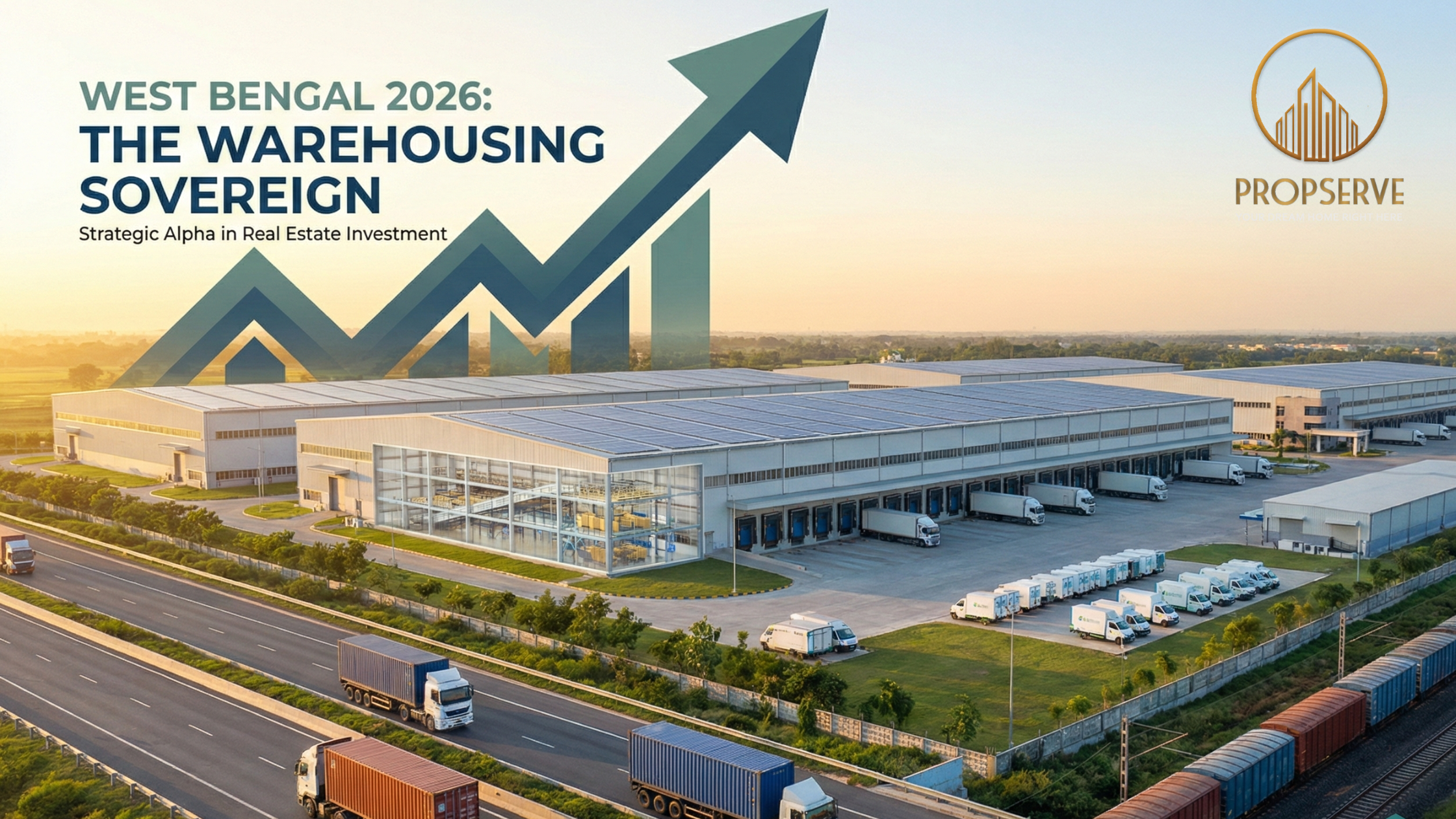
The West Bengal real estate landscape in 2026 is defined by a sharp divergence in performance. While traditional residential and commercial office sectors navigate structural saturation and compressed yields, the industrial and logistics sector has decoupled from these headwinds. At Propserve, we view this not merely as a trend, but as a fundamental shift in the regional investment hierarchy.
For the institutional investor or the discerning family office, warehousing has emerged as the preeminent “safe harbor” for capital. This 2026 investment thesis explores the trifecta of forces—policy de-risking, geographic monopoly, and infrastructure maturity—that make warehousing the safest real estate asset class in the East.
The Institutionalization of an Asset Class
The era of the “unorganized godown” is over. In its place stands a sophisticated asset class characterized by long-term, bond-like cash flow visibility.
A prime example is the landmark 20-year lease agreement signed by Amazon in Hooghly in late 2025. With a 5-year lock-in and structured rental escalations, such transactions transform real estate into high-credit financial instruments. When global conglomerates commit to multi-decadal tenures, it signals a profound confidence in the region’s long-term logistical viability. For the investor, this translates to unparalleled income security and capital preservation.
The Geographic Monopoly: A Structural Moat
The “safety” of any real estate investment is intrinsically linked to the non-replicability of its demand. West Bengal possesses a geographic monopoly that insulates its logistics sector from competitive erosion:
- The Siliguri Corridor (The “Chicken’s Neck”): As the sole artery connecting mainland India to the North Eastern states, Siliguri is a mandatory transit and consolidation hub. The entry of institutional players like TVS Industrial & Logistics Parks validates that this region is no longer a discretionary transit point but a strategic necessity.
- The International Gateway: Serving as the primary maritime and land-linked gateway for Bangladesh, Nepal, and Bhutan, West Bengal’s warehousing demand is fortified by international trade treaties. This creates a baseline of demand that remains resilient even during domestic economic downturns.
Regulatory Alpha: The Impact of “Industry Status”
The most significant catalyst for “safety” in 2026 is the full operationalization of the West Bengal Logistics Policy. The granting of Industry Status to the sector has fundamentally altered the risk-reward calculus for investors:
- Operational Cost Reduction: Reclassification allows logistics parks to access power at industrial rather than commercial tariffs. For a 100,000 sq. ft. automated facility, this shift significantly lowers the Total Cost of Occupancy (TCO), enhancing the tenant’s rent-paying capacity.
- Reduced Cost of Capital: Financial institutions now assign lower risk weights to industrial infrastructure. Investors can access debt at rates 100–200 basis points lower than speculative commercial construction loans, creating a “positive leverage” scenario that boosts equity returns.
Comparative Market Dynamics: 2026 Data Points
To declare warehousing the “safest” bet requires a rigorous comparison with traditional alternatives. The data from Q1 2026 is unequivocal:
| Metric | Warehousing (Grade A) | Commercial Office | Residential |
| Gross Rental Yield | 7.5% – 9.0% | 7.0% – 8.5% | 2.5% – 3.5% |
| Vacancy Rate | ~9.7% (Tight) | ~29.9% (Oversupplied) | Moderate |
| Lease Tenure | 9 – 20 Years | 3 – 9 Years | 11 Months |
| Capital Intensity | Low (PEB structures) | High (Vertical Rises) | Medium |
While the office market struggles with vacancy overhangs and residential yields fail to beat inflation, warehousing provides a high-yield environment underpinned by a landlord-favorable supply-demand gap. (Read more in our Market Analysis Report)
Infrastructure: The Bedrock of Valuation
The physical connectivity of West Bengal has reached a level of maturity that creates high barriers to entry for competing regions.
- The Dankuni Hub: As the termination point for the Eastern Dedicated Freight Corridor (EDFC), Dankuni is the undisputed logistics capital of the East. The integration of Private Freight Terminals (PFTs) allows for seamless rail-to-road transfer, minimizing cargo risk and maximizing efficiency.
- The Tajpur Catalyst: The Tajpur Deep Sea Port remains the single largest catalyst for future capital appreciation. For the 2026 investor, Tajpur represents the “Alpha”—the potential for massive re-rating of land values along the Dankuni-Tajpur axis as construction progresses.
Strategic Investment Clusters
At Propserve, we guide our clients through a micro-market selection process based on their specific risk appetite:
- Dankuni/NH-19: The “Core” play. Ideal for institutional investors seeking yield preservation and blue-chip tenants.
- Uluberia/NH-16: The industrial-logistics mix. Excellent for 3PL (Third-Party Logistics) and auto-ancillary distribution.
- Siliguri/Fulbari: The “Frontier” play. High growth potential driven by the rapid formalization of North East trade.
Risk Mitigation with Propserve
While warehousing is structurally safe, execution requires precision. We assist our partners in navigating:
- Land Due Diligence: Leveraging government land banks and WBIDC industrial parks to ensure “clean” entry.
- Technical Specifications: Ensuring assets meet global Grade A standards (FM2 flooring, clear heights, and solar readiness) to attract MNC tenants.
- ESG Compliance: Aligning with the 2023 “Green Logistics” mandates to future-proof the asset against evolving regulations.
Conclusion: The Definitive “Buy”
In the fiscal climate of 2026, the warehousing sector in West Bengal stands alone as the asset class that optimally balances safety, yield, and growth. It is no longer a peripheral real estate play; it is the infrastructure of the East’s consumption economy.
Propserve: Your Trusted Partner in the Real Estate Journey. We provide the strategic oversight and ground-level intelligence required to navigate this high-performing sector. Whether you are looking to acquire income-generating assets or develop build-to-suit facilities, our expertise ensures your investment is anchored in the most resilient corridors of the state.
Contact our Investment Team today to discuss your 2026 portfolio strategy.
The Propserve Guide: Your Top Warehouse Vastu Queries Answered
Why is warehousing considered “safer” than residential real estate in 2026?
The “safety” lies in the lease structure and yield. Residential yields in West Bengal currently hover around 2.5% – 3.5%, while Grade A warehousing offers 7.5% – 9.0%. Additionally, warehousing involves long-term, multi-year contracts with corporate giants (like the 20-year lease examples in Hooghly), providing bond-like security that residential “11-month” agreements cannot match.
Can I invest in warehousing with a smaller budget?
While direct land acquisition is capital-intensive, 2026 has seen a rise in REITs (Real Estate Investment Trusts) and fractional ownership models. These allow smaller investors to participate in Grade A warehouse portfolios with lower entry points, though direct “build-to-suit” projects remain the gold standard for maximum control and yield.
Which are the top “Investment Hotspots” in West Bengal for 2026?
We categorize the market into three strategic zones:
Dankuni (The Core): The undisputed king due to its proximity to the Dedicated Freight Corridor (EDFC).
Uluberia (The Industrial Hub): Perfect for 3PL and auto-ancillary distribution.
Siliguri (The Gateway): A high-growth “frontier” play that acts as the sole artery for North East trade and international transit to Nepal and Bhutan.
What is the impact of the Tajpur Deep Sea Port on land values?
Tajpur is the “Alpha” catalyst for 2026. As construction progresses, the entire Dankuni-Tajpur axis is undergoing a massive re-rating. Early investors are looking at significant capital appreciation as the port transforms West Bengal into the primary maritime gateway for the East and neighboring landlocked countries.
Join The Discussion